Skip to content

Public engagement at IPDLN conference 2026: from mistrust to meaningful involvement

A building at Erasmus University, Rotterdam. Vinyl text on windows reads
Blog posts

Katie Oldfield (Senior Engagement Manager) and Rachel Edwards (Public Engagement Officer) | Average reading time 5 minutes

28 Jul 2026

Discover insights from the RDS Engagement Team on their recent trip to IPDLN conference in Rotterdam.

On 13th July, the Research Data Scotland (RDS) Engagement Team packed up our posters, prepped our talks, and set off to Rotterdam to attend the International Population Data Linkage Network (IPDLN) Conference.

With hundreds of attendees from across the world, we were excited to hear from others, improve our practice and share our work (plus try a local Bitterballen or two!). Sessions ranged from data linkage techniques to data research findings, but amongst it all was a thread on the importance of social licence, trust and supporting the public to be involved.

The importance of public trust

We often think of public mistrust in data as a modern problem, but Steve Ruggle’s (IPUMS, University of Minnesota) keynote showed that concerns about data use have existed for decades. In 1946, a proposal to link records and create a ‘book of life’ for every American promised major benefits for research and public services, but public mistrust ultimately prevented it from moving forward.

Over time, public engagement practices have become more prevalent, but the theme of mistrust resurfaced throughout the conference. In particular, conference talks covered how the removal of datasets and restrictions on data use can weaken both research and public confidence.

Speakers also highlighted challenges around bias, representation, and language used by researchers and data professionals. Against this, Amy Nelson (University of Pennsylvania) posed a powerful question: "How can we rebuild to make data more equitable and make public participation the norm?" Together, these discussions highlighted that trust cannot be taken for granted. It must be actively built.

Building trustworthiness

Building trustworthiness requires more than simply asking people if it’s ok to share their data. The public needs meaningful opportunities to shape how data is collected, used and governed. This is particularly important to consider when engaging with historically underrepresented and underserved populations, such as minority communities.

Throughout the conference, speakers shared inspiring examples of meaningful engagement with the public, including community-led focus groups, co-designed workshops and partnerships with trusted local organisations. A key theme was the need to bring together people with lived experience and trusted community leaders, such as First Nations Grandmothers in Canada. This created safe spaces where community members could share their perspectives directly with service providers and researchers to help shape decision-making.

“Data has spirit”

Carla Cochrane, Data Sovereignty Implementation Lead, First Nations Health and Social Secretariat of Manitoba

Workshops that used simple, relatable analogies, such as comparing data linkage to matching pizzas, helped participants move from feeling worried about data use to feeling curious and engaged.

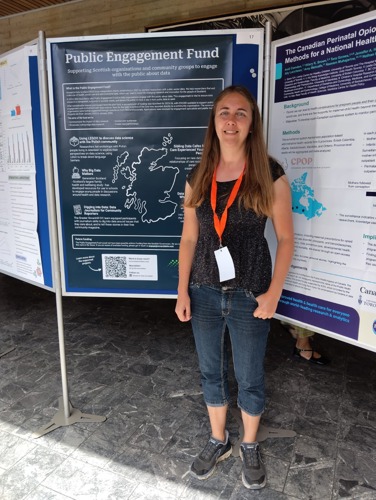
There was also a strong focus on building understanding from an early age, with resources designed to help young people make informed decisions about data throughout their lives. This included a talk by Generation Scotland, who spoke about their project funded by our Public Engagement Fund. We showcased this project, alongside our other funded projects, in a poster at the conference.

Poster - PE Fund Rachel 2.JPG

Rachel Edwards, Public Engagement Officer at IPDLN conference 2026

Through creative approaches including storytelling, co-development, data training and education, speakers at the conference showed that we can collectively build trustworthiness in data. The public show greater support when they understand how data is used, see clear public benefits and have a genuine role in shaping research.

Building supportive infrastructure

Talks also highlighted how public involvement and engagement can influence policy, improve data governance and build our understanding of public attitudes towards data use.

One of our posters at the conference highlighted our report on public opinions of private sector access to data, which informed a framework for data controllers to help ensure public perspectives are reflected in decisions about data access.

Similar work from the Maritime SPOR SUPPORT Unit (MSSU) in Canada also explored public attitudes to private sector data access, with methods and findings that closely mirrored our own, despite operating in different data landscapes and being separated by the Atlantic Ocean!

In both MSUU’s work and our own, participants wanted reassurance that data use would deliver public benefit rather than solely financial gain and stressed the importance of transparency around data protection.

Closer to home, Liverpool’s Community Charter on Data and AI demonstrated how engagement can influence practice. Co-developed with local residents, the charter sets out 11 principles to complement legislation and provide practical recommendations for trustworthy data sharing. Initiatives like this illustrate how public perspectives can help shape policy and practice around emerging technologies, ensuring trust remains at the heart of innovation.

“[I hope] what we're doing with this [...] drafting the principles of the Charter [is] going to be utilised and it's going to be respected, and this isn’t just paying lip service to something that we hope might happen. You know, this is actually going to be taken seriously.”

Public Participant in Liverpool’s Community Charter in Data AI sessions

While it was interesting to see the similarities between RDS’s work and others across the world, the conference also highlighted some of the different strengths in PIE infrastructure internationally. The UK, for example, benefits from established expectations around public engagement and contributor payments, while Canada and Australia showcased their strong approaches for involving under-represented communities, particularly First Nations peoples.

All the IPDLN talks demonstrated the value of sharing experiences and learning from different approaches. By working together, and creating a culture of public involvement and engagement, we can strengthen our approach with the public and develop more transparent, inclusive, and trustworthy data practices worldwide.

Related content

Series of pins connected by looping wire to mirror a connected system

Federation ready? SATRE 2.0 is here

New guidance for the federation of Trusted Research Environments (TREs) has been launched as part of a major update to the SATRE specification led by the Health Informatics Centre (HIC) at the University of Dundee.

15 Jul 2026

Subscribe to our updates 

To stay updated with Research Data Scotland, subscribe to our monthly newsletter and follow us on LinkedIn.

Subscribe to our newsletter
Illustration of an envelope with a letter sticking out and a mobile phone with a person