

Edinburgh Science Festival 2026
Join Research Data Scotland (RDS) at this year’s Edinburgh Science Festival as part of the University of Edinburgh’s 7 Days, 100 Scientists programme.
24 Feb 2026

Victoria Bell, Lucy Xu and Naomi Greenberg | Average reading time 5 minutes
16 Mar 2026
RDS welcomed Victoria Bell, Lucy Xu and Naomi Greenberg on student placements at the start of this year, as part of their studies at the University of Edinburgh. Read all about their experience at Dundee Science Festival.
Research Data Scotland enjoyed taking part in a lively and engaging weekend at the Dundee Science Festival on 14 and 15 February. Together with colleagues from the Health Informatics Centre (HIC), the University of Dundee and St. Andrews University, the RDS team delivered interactive activities designed to spark curiosity and connection.
Through hands-on experiences and informal discussions, our team explored how research data is accessed securely, how projects are developed, and how public sector data can be used to understand and respond to real world challenges such as antimicrobial resistance. From young scientists proudly designing their own “superbugs” to adults asking thoughtful questions about data safety and governance, attendees had the opportunity to engage with us about the role of data research in improving health and education outcomes across Scotland.
Joining the team were Victoria, Lucy and Naomi, three MSc students in Science Communication and Public Engagement at the University of Edinburgh, completing placements with RDS. You can read their reflections on the festival in this blog.
Saturday began with a steady stream of visitors, building into a lively lunchtime rush and energetic afternoon. As families filled the space, the buzz around the activities grew quickly, and from that point on there was a steady flow of visitors eager to take part. I quickly realised it would be a dynamic afternoon, filled with conversations and curiosity.
The Superbug Showdown activity sparked particular excitement among younger attendees. Children designed their own bacterial “superbugs,” proudly presenting their creations and explaining the thinking behind them. I was struck by how confidently they described infection, resistance, and why they made their decisions. It was a reminder that complex scientific ideas can become accessible remarkably quickly when explored through hands-on activities.
The LEGO: Use Data for Research station was also popular. Children stepped into the role of researchers, choosing to study infections or antibiotics and identifying factors that might influence their project, such as age, gender, location, or number of hospital visits. Using chests of colour-coded LEGO bricks as datasets, they combined pieces of information to build their own research story. Watching them physically construct their “research” helped bring abstract ideas about data access and linkage to life in a way that felt both playful and thoughtful.
The energy carried through to the feedback and evaluation table, where I spent much of the day. One of the most rewarding moments for me was hearing children reflect on what they knew about data and superbugs before arriving and what they had learned during their visit. Many were proud to explain not just what they had built, but what it meant.
Working alongside colleagues from HIC and the Universities of Dundee and St Andrews added another layer to the experience. Seeing how research infrastructure, data services and academic expertise connect in practice strengthened my understanding of how collaborative the data landscape truly is.
Overall, the weekend reinforced the value of hands-on public engagement for me. When complex ideas are explored through building, discussion, and play, they become easier to understand and far more memorable, both for participants and for those of us facilitating the conversations.
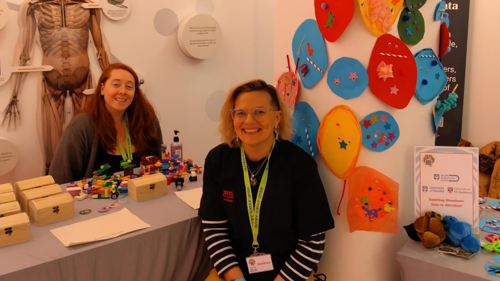
Sunday morning saw a quieter start, perhaps thanks to the lovely sunshine outside. When we arrived at the Dundee Science Centre, Lucy and I had a chance to look around the other displays. We learned about water conservation with Scottish Water and extracted DNA from strawberries with microbiome researchers at the University of Dundee. We also explored the permanent exhibits at the Dundee Science Centre, which were a great reminder of basic science concepts like centrifugal force and the effects of the earth’s rotation.
Once the crowds started to pick up, we took our stations at the RDS activities. I oversaw the LEGO activity, where we showed attendees how to handle data responsibly. Our attendees loved piecing together LEGO bricks. While the youngest ones were simply there to play, the older participants seemed to grasp the importance of keeping their blocks (or data) within the safe research environment. Parents and other adult attendees were curious to learn how RDS helps to provide access to public sector data, making it easy for researchers to combine multiple datasets.
Additional links between the LEGO-building activity and public sector data research emerged throughout the day. For example, some participants started by looking at the existing LEGO creations for inspiration. This is a lot like researchers reading existing research to help frame their research questions. Some participants even took existing LEGO creations and built upon them, just like researchers often build upon prior knowledge.
For me, the festival showed me the value of pure wonder and curiosity. While some participants left our stations having learned exactly our stated aims, others learned completely different skills or ideas. When we let participants learn with flexibility, they derive both joy and understanding from our activity.
I was really pleased to have the chance to walk participants through each activity. Although I was there as an instructor, I quickly realised I was learning just as much as the young scientists who joined us. At the LEGO station, for example, I watched children do the task in different ways. Some of them collaborated, building something together. This seemed to me a perfect reflection of how scientists collaborate in real-world research. Some attendees created robust and sturdy structures, while others built intricate and elegant designs. It struck me that research can be like this too: varied in both style and uses. There are always creative ways to generate new knowledge.
Throughout the day, I heard attendees speak highly of the ways the activities helped visualise how data is linked and safely used, and how we translated complex ideas into tangible experiences. As I’ve learned in my time at RDS so far, the organisation is always committed to developing innovative approaches that help researchers access and use data simply and responsibly for public benefit.
I’m grateful to everyone who stopped by our stations. I was inspired by the creativity, collaboration, and thoughtful questions from the next generation of scientists. I even left the event feeling somewhat envious of our younger participants, who get a glimpse of the fascinating world of science at such a young age! I also felt fortunate to engage with future scientists, researchers, and young minds who are curious about the world.
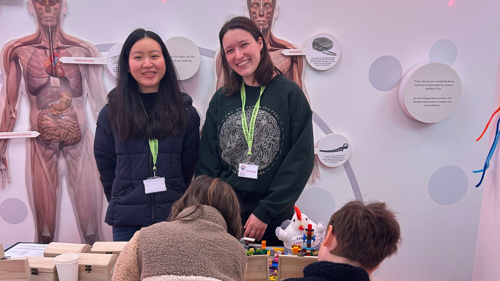
Building on the energy from Dundee, RDS will be taking part in the Edinburgh Science Festival 2026 as part of the University of Edinburgh’s 7 Days, 100 Scientists programme. The festival runs from 7-13 April at Stratosphere, Dynamic Earth, and RDS will be exhibiting from 7-10 April.
Presenting four themed days covering mental health, environment and young people, cardiology, and cognition and asthma, RDS will highlight how researchers access de-identified public sector data, how it is kept secure within Trusted Research Environments, and how it contributes to real-world impact throughout Scotland.
Events like the Dundee Science Festival demonstrate the importance of creating space for open conversation about how data is used in research. Whether designing a “superbug,” building LEGO datasets, or discussing data governance with families, these moments help attendees understand the power of public sector data to address questions that can positively impact everyone in areas such as healthcare, education, social care, public services, and policy decisions.
As MSc students in Science Communication and Public Engagement, weekends like this offer more than event experience. They remind us why accessible, thoughtful engagement matters and how research truly comes to life through conversation, curiosity, and collaboration. Seeing participants connect scientific ideas to everyday life reinforced the importance of clear communication and trust in research. It is an experience that will shape how we approach public engagement and science communication in our future work.
Related content
Join Research Data Scotland (RDS) at this year’s Edinburgh Science Festival as part of the University of Edinburgh’s 7 Days, 100 Scientists programme.
24 Feb 2026

Research Data Scotland welcomes an investment of £25million in ADR Scotland, securing the future of the programme until 2031.
05 Mar 2026
To stay updated with Research Data Scotland, subscribe to our monthly newsletter and follow us on LinkedIn.